
The short answer
A percolation test measures how fast water soaks into the soil where a drainage field would go. You dig a 300 millimetre square hole, fill it with water, and time how long the level takes to fall. The result, called Vp, is in seconds per millimetre. Building regulations only allow a drainage field where the average Vp is between 12 and 100.
It is the test that decides whether a septic tank will work on a site, and how big the drainage field has to be.
Before the test, a trial hole
Approved Document H asks for a trial hole first, to find the groundwater level. It should be at least 1 square metre in area and 2 metres deep, or at least 1.5 metres below where the drainage pipes would sit. The groundwater must not rise to within 1 metre of the pipes. If you dig in summer, allow for the higher water table in winter. Soil colour helps here. Brown, yellow or reddish subsoil usually drains well, while grey or blue soil, or brown and grey mottling, suggests the ground gets waterlogged.
How the percolation test works
- Dig a hole 300 millimetres square, going 300 millimetres below the level where the drainage pipes will be laid.
- Fill the bottom 300 millimetres with water and leave it to drain away overnight. This wets the soil around the hole.
- Next day, fill it to at least 300 millimetres again.
- Time, in seconds, how long the water takes to fall from 75% full to 25% full, a drop of 150 millimetres.
- Divide that time by 150. The answer is Vp, the average time in seconds for the water to drop 1 millimetre.
The test should be done at least three times, in at least two holes, and the results averaged. Avoid heavy rain, hard frost and drought, all of which give misleading figures.
A worked example
Say the water takes 4,500 seconds, which is 75 minutes, to fall from 75% to 25% full. Dividing 4,500 by 150 gives a Vp of 30. That is within the 12 to 100 range, so a drainage field is possible on that spot, subject to the trial hole and other checks.
What the result means
| Average Vp | What it means |
|---|---|
| Under 12 | The ground drains too fast. Effluent could reach groundwater before it is treated. Engineered ground or another approach is needed. |
| 12 to 100 | A drainage field is possible. The higher the figure, the bigger it has to be. |
| Over 100 | The ground drains too slowly for a drainage field. Look at a treatment plant discharging to a watercourse, a mound, or other options. |
Since 23 July 2026 the general binding rules accept ground that has been engineered to slow fast drainage, provided it reaches a Vp of at least 15, is outside a floodplain and follows BS 6297:2007.
How Vp sets the drainage field size
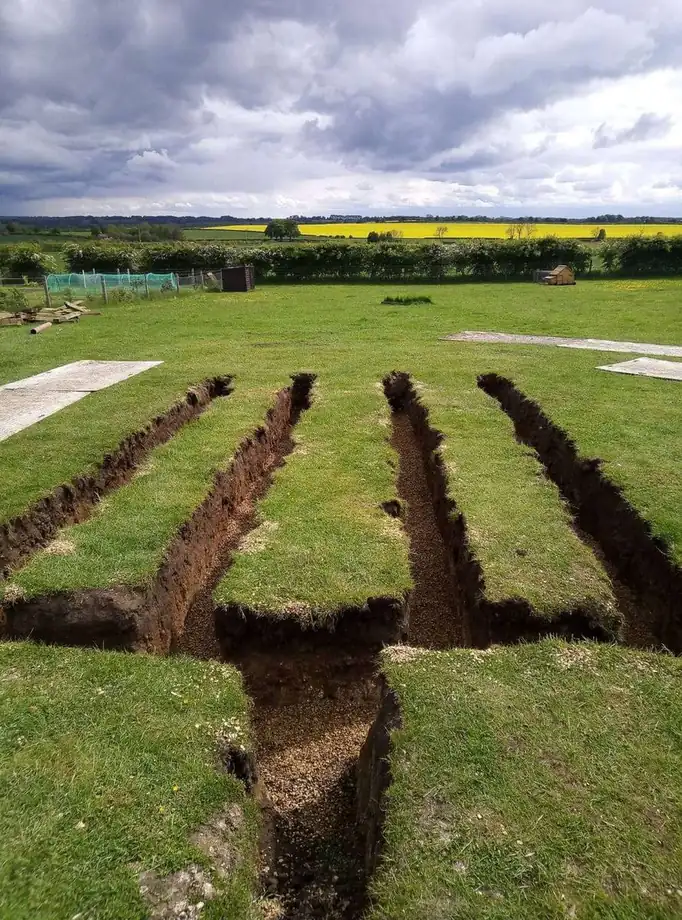
The building regulations formula multiplies the number of people by Vp and by 0.25 to give the floor area of the drainage trenches. So the same household needs a much larger field on slow ground than on fast ground. Our guide to how big a drainage field should be works through examples.
Which soils usually pass?
Approved Document H lists sand, gravel, chalk, sandy loam and clay loam as soils with good percolation, and sandy clay, silty clay and clay as poor. That is a guide only. A clay loam can test well and a sandy soil over a hard layer can fail, which is why the test matters. If your ground is heavy, our guide to a septic tank without a drainage field covers the alternatives.
Can you do it yourself?
The method is simple enough to try, and a rough result can tell you early whether a drainage field is likely. For an installation, building control will want a test carried out and recorded properly, at the depth of the planned pipes and in the right place. Deep holes also need care, because trench sides can collapse.
We carry out trial holes and percolation tests as part of every design. See septic tank installation and sewage treatment plant installation.
Method taken from Approved Document H, paragraphs 1.33 to 1.38. Checked on 15 October 2026.