
The short answer
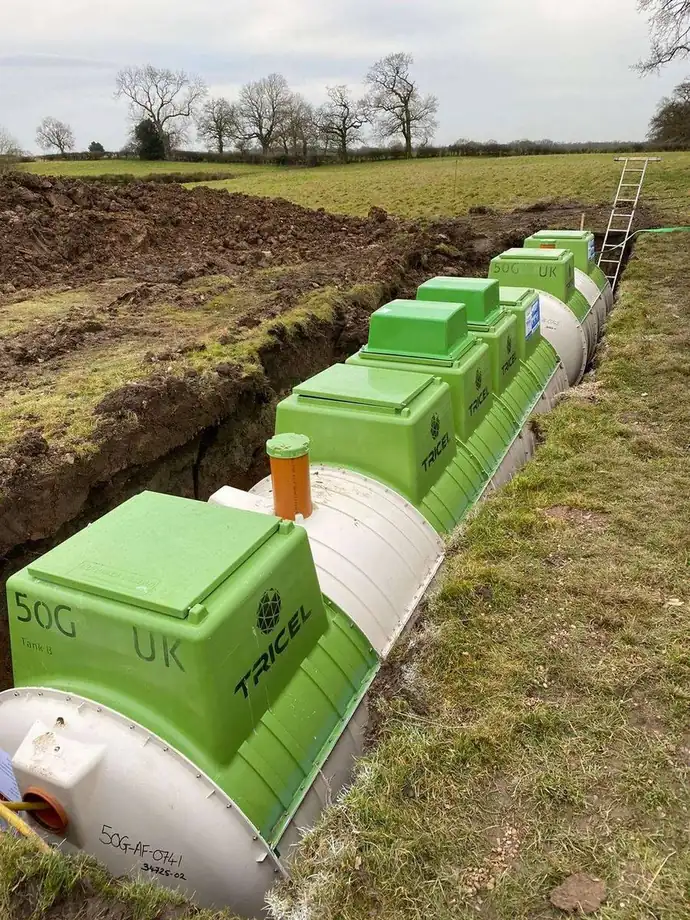
A sewage treatment plant is a compact unit, usually buried in the garden, that treats a home's wastewater using air and bacteria. It produces effluent clean enough to discharge to a stream or to a smaller drainage field than a septic tank would need. Unlike a septic tank, it needs electricity and regular servicing.
You may see the same thing called a package treatment plant or a biodigester. In UK domestic drainage these mean the same kind of system.
How does a sewage treatment plant work?
Most domestic plants work in three stages inside one tank.
- Primary settlement. Wastewater enters the first chamber, where solids sink as sludge and fats float, much as in a septic tank.
- Biological treatment. The liquid moves into a chamber where an air blower bubbles air through it. Bacteria that need oxygen thrive there, often growing on plastic media, and digest most of the dissolved waste.
- Final settlement. In the last chamber the remaining particles, mostly clumps of bacteria, settle out. Many plants pump some of this back to the start. Clear effluent then leaves through the outlet.
Manufacturers use different methods for the middle stage. The common ones are submerged aerated filters, activated sludge, sequencing batch reactors and rotating biological contactors. For a homeowner the differences matter less than the quality of the installation and how well the plant is serviced.
What makes it different from a septic tank?
A septic tank only settles the waste, and the soil in the drainage field does the real cleaning. A treatment plant does that cleaning inside the unit, so the effluent is far cleaner when it leaves. That brings two practical benefits. It can discharge to a watercourse that flows all year, and on ground that drains poorly it can often work where a septic tank could not.
The price is electricity and maintenance. The blower runs around the clock, and the plant needs servicing in line with the manufacturer's instructions, which for most means at least once a year. Building regulations also expect a powered plant to cope with a power cut of up to 6 hours, or to have backup power.
Who uses one?
- Homes replacing a septic tank that discharges to a ditch or stream, which the rules no longer allow.
- New builds and conversions on sites where the ground won't take a full drainage field.
- Properties in sensitive areas, where cleaner effluent is expected.
- Holiday lets, small developments and businesses that need more capacity.
What size do you need?
Plants are sized by the number of people they serve, worked out from the number of bedrooms using British Water's Flows and Loads guidance. Even a small house is commonly sized for five people, so the plant copes when the house is full. Holiday lets and businesses are sized on their own figures. A plant that is too small for its load gives poor effluent, and one far too big for a single occupant can struggle to keep its bacteria going.
What are the rules?
In England a treatment plant can discharge without a permit if it meets the general binding rules. Discharges to ground are limited to 2 cubic metres a day, and to surface water 5. New plants must meet BS EN 12566-3. Sludge must be removed at least once a year or as the manufacturer advises. Our guide to where the water goes from a treatment plant explains both discharge routes.
What does it cost?
Price guides for 2026 put a supplied and installed plant for a typical house at roughly £6,000 to £9,500, and more for larger households or difficult ground. Running costs are the electricity for the blower, an annual service and desludging. The blower's diaphragms wear and are commonly replaced every couple of years, which is a modest part.
Is a treatment plant better than a septic tank?
It is better at treating sewage, but that does not make it the right choice everywhere. On good ground with room for a drainage field, a septic tank is cheaper to buy and run. We compare the two in septic tank or sewage treatment plant.
We install, inspect, service and repair domestic treatment plants. See sewage treatment plant installation and treatment plant servicing.
Checked against the GOV.UK general binding rules and Approved Document H on 15 October 2026.