
The short answer
A septic tank is an underground tank, normally with two chambers, that holds a household's wastewater long enough for solids to separate out. Heavy solids sink as sludge and fats float as scum. The liquid in between flows out to a drainage field, where bacteria in the soil finish cleaning it. Nothing in the tank needs power.
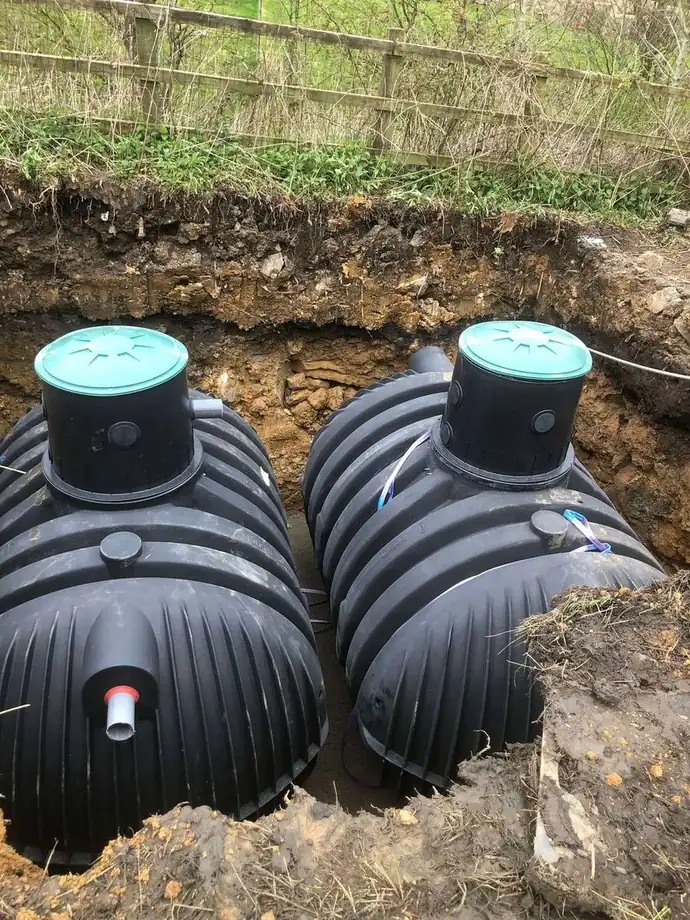
That simplicity is why septic tanks have served rural homes for well over a century. It also explains most of the problems people have with them, because a lot depends on the tank being left to settle undisturbed.
What happens when you flush?
Everything from the toilets, sinks, shower and washing machine runs down one drain to the tank. As it enters the first chamber the flow slows almost to a stop. Solids heavier than water sink to the bottom and build up as sludge. Grease, oils and light material rise to the top and form a crust known as scum.
Bacteria that live without oxygen work on the sludge, breaking some of it down into liquid and gas. They are slow, which is why sludge keeps accumulating and the tank needs emptying regularly.
The partly cleared liquid in the middle passes through a dip pipe or T-piece into the second chamber, which repeats the settling with less material. A second dip pipe takes liquid from below the surface of that chamber and sends it out of the outlet. Drawing from below the surface keeps scum from escaping.
Why two chambers?
Approved Document H, the building regulations guidance for drainage, asks for at least two chambers in series. The second chamber catches solids that the first misses when a big flow arrives at once, such as a bath emptying. Old single-chamber tanks still exist, but they let more solids through to the drainage field.
Where does the liquid go?
To a drainage field. That is a set of perforated pipes laid in trenches of clean stone, usually under the garden. The effluent seeps out of the pipes and down through the soil. Bacteria living in the soil, which do have oxygen, break down most of the pollution that is left, and the water eventually rejoins the groundwater.
The drainage field isn't an optional extra. Septic tank effluent is still heavily polluted, and in England the general binding rules say it must go to a drainage field rather than a ditch or stream. Our guide to septic tank effluent explains what it contains.
What about the smell and gas?
Breaking down sludge without oxygen produces gases, mainly methane, carbon dioxide and a little hydrogen sulphide, the rotten-egg one. They escape through the house's soil vent pipe, which runs up to roof level. A working tank with sealed lids should not smell at ground level. If yours does, our guide to why a septic tank smells covers the causes.
What does a septic tank need from you?
Less than most systems, but it does need some attention. The sludge has to be removed before it fills too much of the tank, at least once a year or as the manufacturer advises under the general binding rules. If it is left, solids wash through to the drainage field and block it, and a blocked drainage field costs far more to fix than a tank costs to empty.
What goes down the drains makes a difference too. Wet wipes, sanitary products, cooking fat and large amounts of strong chemicals all upset the tank in different ways. Rainwater should never be connected to it. Our list of septic tank maintenance dos and don'ts covers the everyday habits.
How is it different from a treatment plant?
A sewage treatment plant adds a stage where air is pumped through the wastewater, so oxygen-loving bacteria do much more of the cleaning inside the unit. That needs electricity and servicing, but the effluent comes out clean enough to go to a stream as well as to ground. A septic tank relies on the drainage field for that second stage. Our guide to the three main types of septic system compares them with cesspools too.
If your tank is slow, smelly or surrounded by wet ground, a septic tank inspection will show which part of the system is struggling. For a new or replacement system, see our septic tank installation service.